White Torture
This is a form of emotional and physiological torture. Instead of beating the victim, electrocuting them, or keeping them in a small box, the victim is tormented with sensory deprivation and isolation. (Source)
 Welcome to Sixpenceee. You’ll find interesting content that ranges a wide variety of topics but our specialty is in creepy/bizarre/horror/paranormal & science. We don't claim any material here unless otherwise stated. For business purposes please contact us at [email protected].
This is a form of emotional and physiological torture. Instead of beating the victim, electrocuting them, or keeping them in a small box, the victim is tormented with sensory deprivation and isolation. (Source)
While the strappado was used heavily during the Renaissance, it seems to have experienced a resurgence during the last century. This is a form of torture where a prisoner is hung by their arms, which are fastened behind their head, causing the arms to be slowly wrenched from the shoulder sockets by the weight of the body. When the prisoner finally becomes so tired they cannot hold themselves upright, their bodies fall forward and their breathing is impaired. (Source)
Torture Method: Strappado
Strappado is an uncomfortable form of torture that, unlike many of the others on this list, doesn’t necessarily end in death. In strappado, the guilty party is strung up by the wrists, behind the head. The awkward angle is pretty much guaranteed to cause an agonizing dislocation of the shoulders, but if it doesn’t weights may be added. Thought to have originated in medieval times during the Inquisition, strappado has been used into the 21st century.
Rope Torture
A rope is the easiest to use of all the torture devices since it is easy to find and can easily be fashioned to inflict a number of terrible retributions. For example, it could be used to tie the victim to a tree leaving the victim exposed with no way of defending himself from animals or other humans; it could be used to hang victims at the gallows for entertainment purposes while ultimately inflicting death; and it could be fashioned to restrain the victim’s limbs while attaching the other end to horses who would them be made to run, consequently severing the limbs.
Source: List25
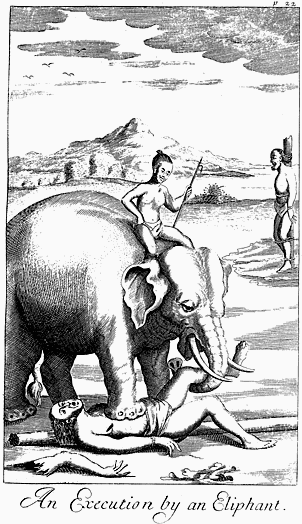
This is a weirdly specific method of execution, but you can’t argue with its effectiveness. As you might guess, it was common in areas where elephants are naturally found, primarily in South and Southeast Asia. Elephants were often trained in order to ensure the trampling was as brutal as possible.
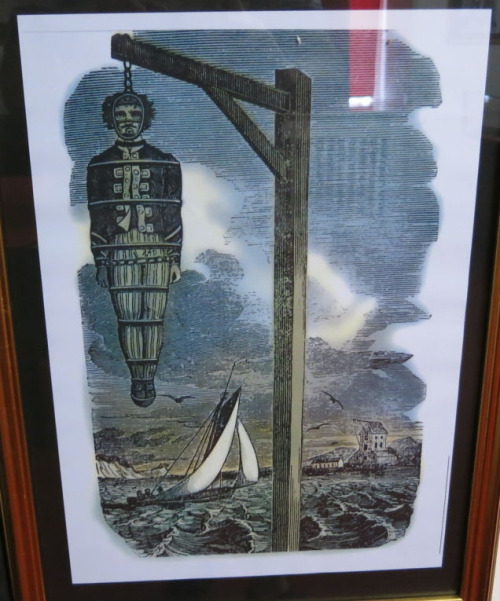
Coffin Torture
This was one of the most dreaded forms of torture during the Medieval Period.The accused were placed inside a caged coffin, rendering them completely immobile. The period of time was determined by the crime, with some infractions, like blasphemy, punishable by death. Victims were often put on public display, where they would be mocked and abused by angry locals.
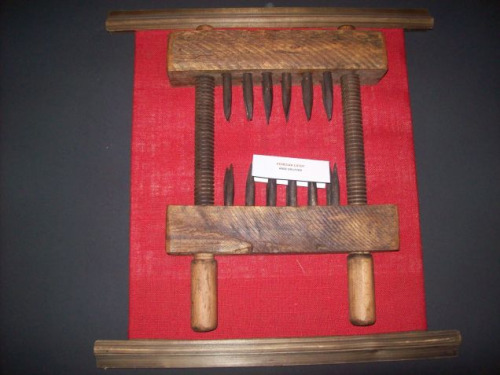
Knee Splitter
Popular during the Inquisition, this device consisted of two spiked wood blocks which were placed in front of and behind the knee. The blocks, which were connected by two large screws, would be turned and made to close towards each other, destroying the knee underneath. The technique would render the knees useless. The number of spikes on the blocks varied from three to twenty, often depending on the nature of the crime and the status of the prisoner. (Source)
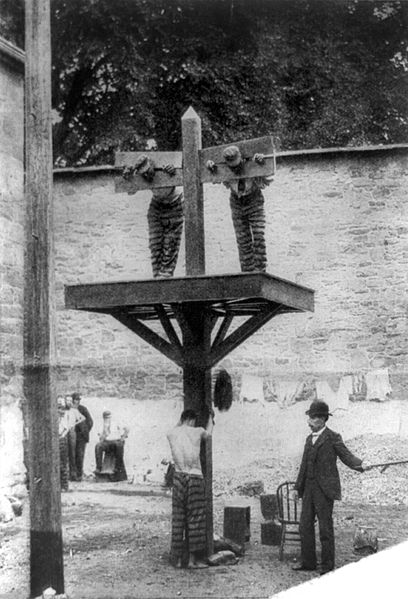
The pillory has been in use for hundreds of years, and was traditionally placed in a public square for public humiliation. It was generally used for more serious crimes than the stocks, and more dangerous crimes too, as criminals were pelted with everything from rotten food to stones that could cause death. The above image from New Castle County Jail in Delaware shows how this device was also used as a whipping post, a combination of pillory and post, if you will. The pillory continued to be in use at least until 1907 in Delaware, the year in which the photograph above was taken. (Source)
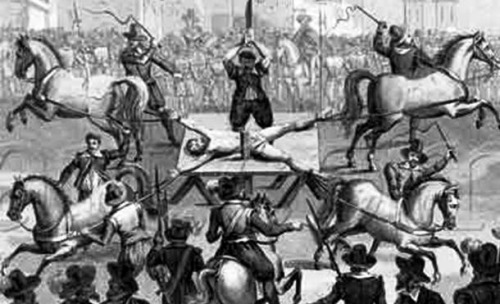
Hanged, Drawn, and Quartered
During medieval times, the penalty for high treason in England was to be hanged, drawn and quartered in public and though it was abolished in 1814, it has been responsible for the death of thousands of people. In this torture technique, the victim is dragged in a wooden frame called a hurdle to the place of execution. They would then be hanged by the neck for a short period of time until they are near-death (hanged), followed by disembowelment and castration where the entrails and genitalia are burned in front of the victim (drawn). The victim would then be divided into four separate parts and beheaded (quartered). (Source)
For more posts, follow sixpenceee.com.
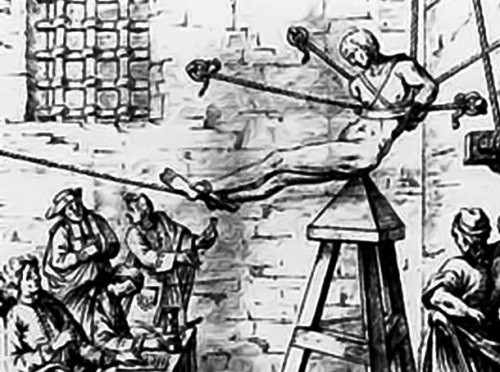
The Judas Cradle
Closely related to impalement, this gruesome punishment entailed having the victim sit on the pyramid-shaped cradle, after which they would be forced down on it by ropes with the intent of stretching the victim’s orifice over a long period of time, slowly impaling them. To add to the overall humiliation, the victim was usually naked and the device was rarely washed. So if the torture did not kill you, the infection contracted from it would. (Source)
For more posts, visit sixpenceee.com.