These spiders, called mirror or sequined spiders, are all members of several different species of the thwaitesia genus, which features spiders with reflective silvery patches on their abdomen.
The scales look like solid pieces of mirror glued to the spider’s back, but they can actually change size depending on how threatened the spider feels. The reflective scales are composed of reflective guanine, which these and other spiders use to give themselves color. (Source)
The beautiful and intricate abdomen of a ravine trapdoor spider. They are a burrowing spider, inhabiting sloping riverbanks and ravines in Georgia, Alabama, and Tennessee. The use their abdomen to block the entrance of their 7 to 15 cm deep vertical burrows when threatened, a phenomenon called phragmosis. (Source)
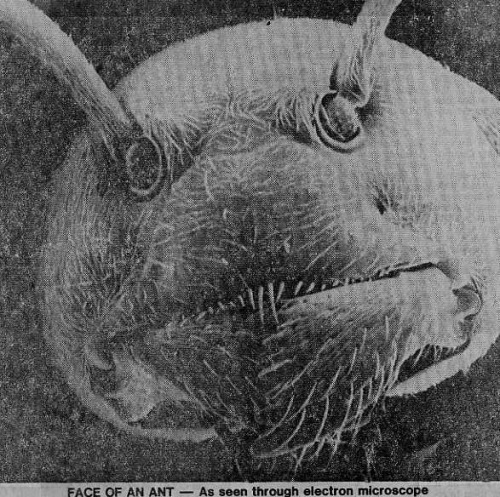
An ant seen through an electron microscope. Well this sure is creepy.
The Golden Silk Orbweaver is a large species of spider. While males typically remain small, females can grow up to 3 inches. It is a tropical climate spider and can be found in Southeastern U.S. They are not aggressive towards people and are considered relatively harmless. What is pretty scary is that they sometimes snack on small birds & snakes.
The cobalt blue tarantula is native to Myanmer & Thailand. It inhabits the tropical rain forests. It’s very aggressive.Its defense is its strong, vertical fangs, which can inflict a painful bite. Its venom is not poisonous to humans. It can go for extended periods of time without food. It appears black to the naked eye. However, upon closer inspection or under the right light, its true bright blue color becomes stunningly apparent. (Source)
 Welcome to Sixpenceee. You’ll find interesting content that ranges a wide variety of topics but our specialty is in creepy/bizarre/horror/paranormal & science. We don't claim any material here unless otherwise stated. For business purposes please contact us at [email protected].