Here are some additional pictures of the California solar farm as discussed in this post.
(Source)
Mariana Trench
Better known as the deepest point on earth’s surface, this trench lies
in Pacific Ocean, at Challenger Deep. Located at a depth of about 10.91
km or 11,033 meter or 36,204 feet below sea level, this trench runs for 2,550
kilometer, somewhere below the expanse of water lying between Australia
and Japan.
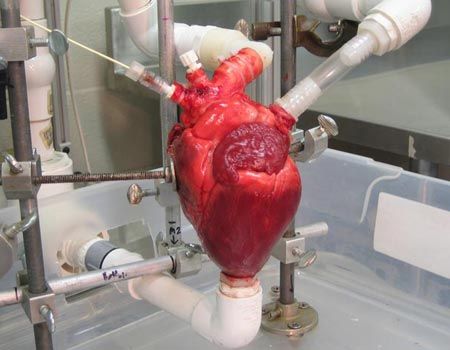
Reanimation with Dead Hearts
Researchers in California were successfully able to transplant “dead,” nonbeating hearts into young baboons.
Although each of the subjects eventually died, they say that their
findings suggest that we should one day be able to transplant “dead”
hearts into humans, too. (Source 1, Source 2)
Frankenmouse!
Remember this little mouse with the ear on top?
Creatively dubbed “earmouse,” this little guy was originally held up as
evidence that genetic engineering had gone too far. In reality, a
better name for him may have been frankenmouse—he’s the product of
simple stitching, not genetic engineering. Earmouse’s creators molded sterile, biodegradable mesh into the shape of a human ear,
which they seeded with bovine cartilage cells. To grow the ear, they
needed a power source, so they stitched the ear-shaped scaffold onto a
nude mouse (pictured above), a mouse with no immune system. Once it was
stitched on, the mouse’s own blood vessels infiltrated the scaffold,
nourishing the incipient ear. By the time the scaffold dissolved, the
ear was sturdy enough to stand on its own—and thoroughly creeped
everyone out.
(Source)
The Demon Core
During experiments with a sphere of plutonium nicknamed the “demon core”
at Los Alamos laboratory, scientist Louis Slotin died when a
screwdriver slipped and the sphere went supercritical. After the room
grew hot and was suffused in a ‘blue glow,’ he saved the lives of seven
other people, but died from severe radiation exposure.
Sources: Trinity Atomic Website and Wikipedia & i09
The larger of Mars’ two moons, Phobos, orbiting in front of Mars.
Image via Mars Express / ESA / DLR / FU Berlin (G. Neukum).
The Mars Express orbiter captured this stunning view of the north polar
region of Mars in January, 2012. Credit: ESA/DLR/FU Berlin (G. Neukum)

Flash of Light
A sweet red pepper is shot against a sunflower to colourful and dramatic effect.
Photograph by Alan Saller (Source)
Optogenetics
A biotech system that allows scientists to turn neurons in your brain on
and off using different colors of light. The technique, which requires
brain implants, already works in rodents, who can be compelled to turn
in a specific direction. Imagine what would happen if optogenetics were
used to regulate human behavior.
(Source)
 Welcome to Sixpenceee. You’ll find interesting content that ranges a wide variety of topics but our specialty is in creepy/bizarre/horror/paranormal & science. We don't claim any material here unless otherwise stated. For business purposes please contact us at [email protected].