A Bullet Leaving a Gun in Slow Motion
GIF made by Sixpenceee. Original video by nikiebc.
 Welcome to Sixpenceee. You’ll find interesting content that ranges a wide variety of topics but our specialty is in creepy/bizarre/horror/paranormal & science. We don't claim any material here unless otherwise stated. For business purposes please contact us at [email protected].
Source: Seametrics
The blue haze on this image of a massive galaxy cluster known as El Gordo is actually a mass map that shows where dark matter is lurking within it. Scientists figured it out by looking at how galaxies in the image are distorted by the dark matter’s gravity. X-ray observations from 2011 are shown in pink and helped scientists work out that the cluster was unusually big for its time. According toNASA, it’s actually a merger between two smaller clusters.
Source: NASA, ESA, and J. Jee (University of California, Davis) / hubblesite.org & BuzzFeed
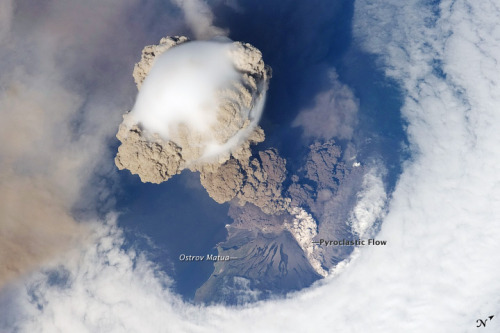
A fortuitous orbit of the International Space Station allowed the
astronauts this striking view of Sarychev Volcano (Kuril Islands,
northeast of Japan) in an early stage of eruption on June 12, 2009. Sarychev Peak is one of the most active volcanoes in the Kuril Island
chain, and it is located on the northwestern end of Matua Island. (Source)
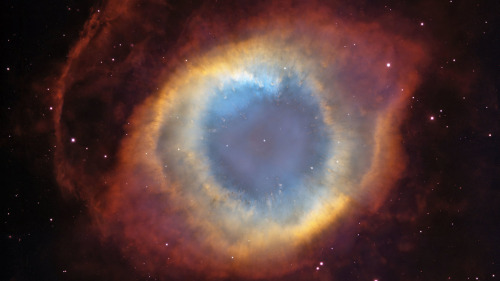
The Helix Nebula, located 690 light-years
from Earth, is a ball of glowing gas expelled from a dying sun-like
star. This image was a composite of a photograph taken by Hubble in 2002
and one by a telescope in Chile in 2003.
Credit
NASA and European Space Agency
& NYTIMES
A team of scientists placed a lightweight sensor to alpine swifts and found that the small migratory birds can remain aloft for more than 200 days without touching down. While in flight, these birds feed on airborne insects and can rest mid air (although exactly how they are able to rest in mid air remains a mystery).
Sea Otters will sometimes hold hands when they sleep so they don’t drift away from each other
The beautiful clouds in this pictures is the result of vapor exhaust from ship engines. These clouds form when water vapor condenses onto particles in the exhaust, which act as seeds for the clouds.
(Source)
This is what an eclipse on Earth looks like from Space
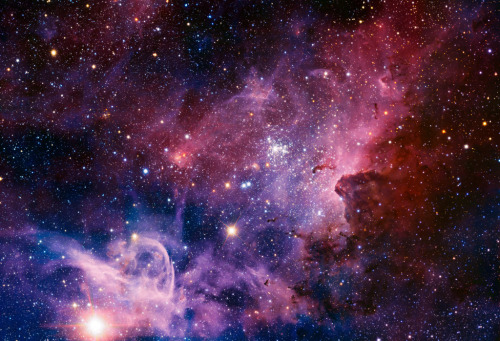
The Carina Nebula is a region of massive star formation in the southern skies. This panorama of the Carina Nebula was taken in infrared light using the HAWK-I camera on ESO’s Very Large Telescope.
(Source)